The Grace-Paced Life
For the parent whose student is paralyzed by the blank page, and the teacher looking for a middle path between ‘banning AI’ and letting it do the thinking for the student.
The Struggle
I cringed as I read it. My daughter’s first research paper. Her thoughts were all over the place. And where was the research? Let’s not even talk about the grammar.
I’m a writer, homeschooling mom, and substitute teacher. Why can’t I teach my daughter to write? This is the one subject I should have well under control!
And yet, writing is one subject that was not under control at that moment. I almost gave up in defeat. Maybe I should just teach her to let AI write for her. But as a writer, I just couldn’t go there. Using AI to write is cheating. Or is it?
I named this space Grace Paced Life because my daughter, Grace, taught me that the best way to learn isn’t to keep up with the crowd. It’s to honor the pace of your own unique brain.
The Middle Path: AI as a Scaffold
What if there was a middle path? A path where using AI didn’t circumvent the thinking and learning process, but supported it? What if I could use AI to support my neurodivergent daughter’s executive function skills while still teaching her to write well?
I found that AI can act like a Socratic Tutor, helping with:
Task Initiation: Breaking the ‘blob’ of an assignment into tiny steps.
Idea Organization: Turning a chaotic brain dump into a logical flow.
Self-Monitoring: Checking work against a rubric without the ‘Mom-as-Nag’ dynamic.
AI could actually help my daughter become a better critical thinker and writer! And that’s when my mission was born. AI is here to stay. Why not use it to help those students who need scaffolding? We can teach students to use AI in ways that help, not harm, their brains.
Meet Lynnae

I’m Lynnae. I’m a homeschooling mom to a neurodivergent high school-aged daughter. I’m also a substitute teacher who very much sees the state of education today.
Every day, I see students struggle to keep up. When I’m at home, it’s my own student. In the classroom, it’s other kids. But the struggle is universal.
I don’t know the reason behind the rise in ADHD and other executive function disorders, but there’s a lot of it out there. Unfortunately, in the classroom, I see many of these kids try to get the easy “A” by using AI to cheat.
And to be fair, the temptation is great. As a substitute teacher, I see the struggle classroom teachers have in trying to scaffold assignments for the wide range of abilities in their classrooms.
But what if AI could do some of the heavy lifting, without replacing the students’ own thinking?
The Grace Paced Difference
If you have a neurodivergent child, you know they march to the beat of their own drums. I found early on that my daughter, Grace, learns differently from her peers.
While many students are competing for good grades (and sometimes…many times…cheating with AI), my daughter needs to learn at her own pace - a pace that honors the way her unique brain works. If she were in a regular classroom, she’d be one of the “hopelessly behind” students. As a substitute teacher, I see these students every day, and it breaks my heart.
I’m teaching her to use AI to help her in the ways she needs help - organizing her many thoughts and remembering to check her work. Just like a nearsighted person needs glasses to see correctly, my daughter needs help with organization and with getting “unstuck” when she feels overwhelmed. AI is a useful tool for that, so I’m embracing it.
Let’s Get Started Together
If your child freezes when starting a writing assignment, I would love to help! Many neurodivergent students get overwhelmed when facing the blank page. If you think about it, it takes a great deal of executive functioning to break down a writing assignment into manageable steps.
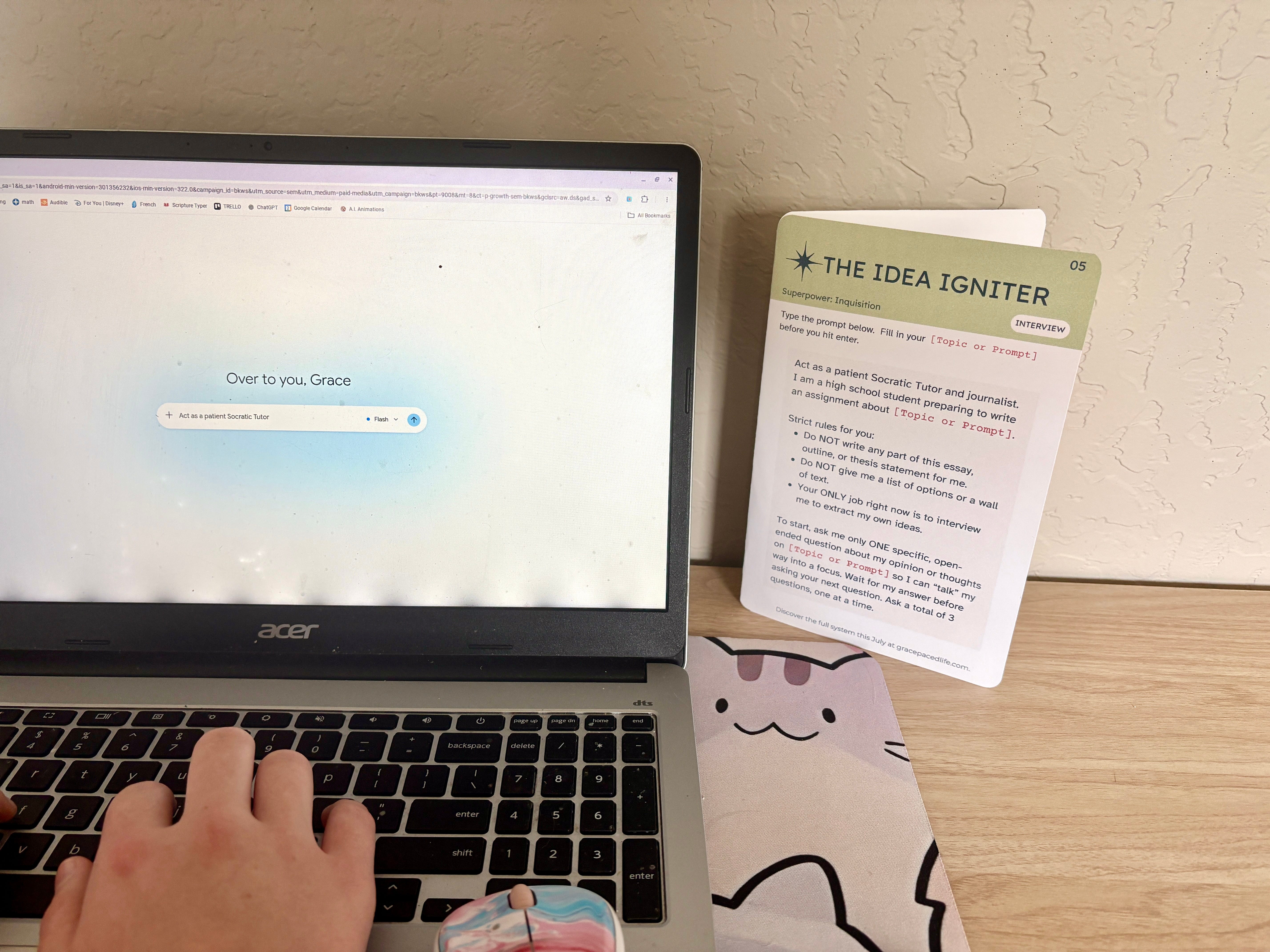
When you subscribe, I’ll send you a digital copy of the Idea Igniter. You can print it, fold it, and prop it up next to your student’s laptop. It’s the first step in moving from ‘I can’t’ to ‘I’ve started.’ This AI prompt helps students organize their initial ideas about a writing assignment before they start writing. By using this prompt card, students don’t have to face the blank page. They begin their assignment with a list of ideas, which makes the writing task much easier.
When you join our community today, you’ll receive:
The Idea Igniter Card: A printable Socratic prompt to break the “blank page” paralysis.
Weekly Scaffolding Tips: Short, scannable strategies for neurodivergent learning.
Early Access: Be the first to know when the full 20-card Digital Deck launches in July.
AI isn’t going away. I hope you’ll join me as I explore how to teach my student to use AI to help her think, rather than use AI to do the thinking for her.
