
As a writer and substitute teacher, I used to view AI as the ultimate enemy of academic integrity. When I saw high schoolers using it to instantly write their essays, I believed it robbed them of their ability to genuinely learn. For a long time, I was firmly on the side of banning AI to protect the educational process.
But as a homeschooling mom to Grace, a neurodivergent high schooler, I know the deafening, anxiety-filled silence of “Blank Page Paralysis.” My entire philosophy—and my fear of AI—was completely challenged last semester as I tried to teach her how to write a research paper. She’s smart. I’m a writing teacher. No problem, right?
Wrong.
Watching her brilliant mind get completely derailed by task initiation made me realize we didn’t need a wall; we needed a bridge. It hit me that just like a nearsighted person needs glasses to see correctly, students with executive function struggles might need AI as an accessibility tool. That was the moment I stopped fighting AI and started looking for the Middle Path: a way to use it as a scaffold, not a shortcut.
Here is what happened during that research paper disaster, and how we solved the problem…
The Struggle
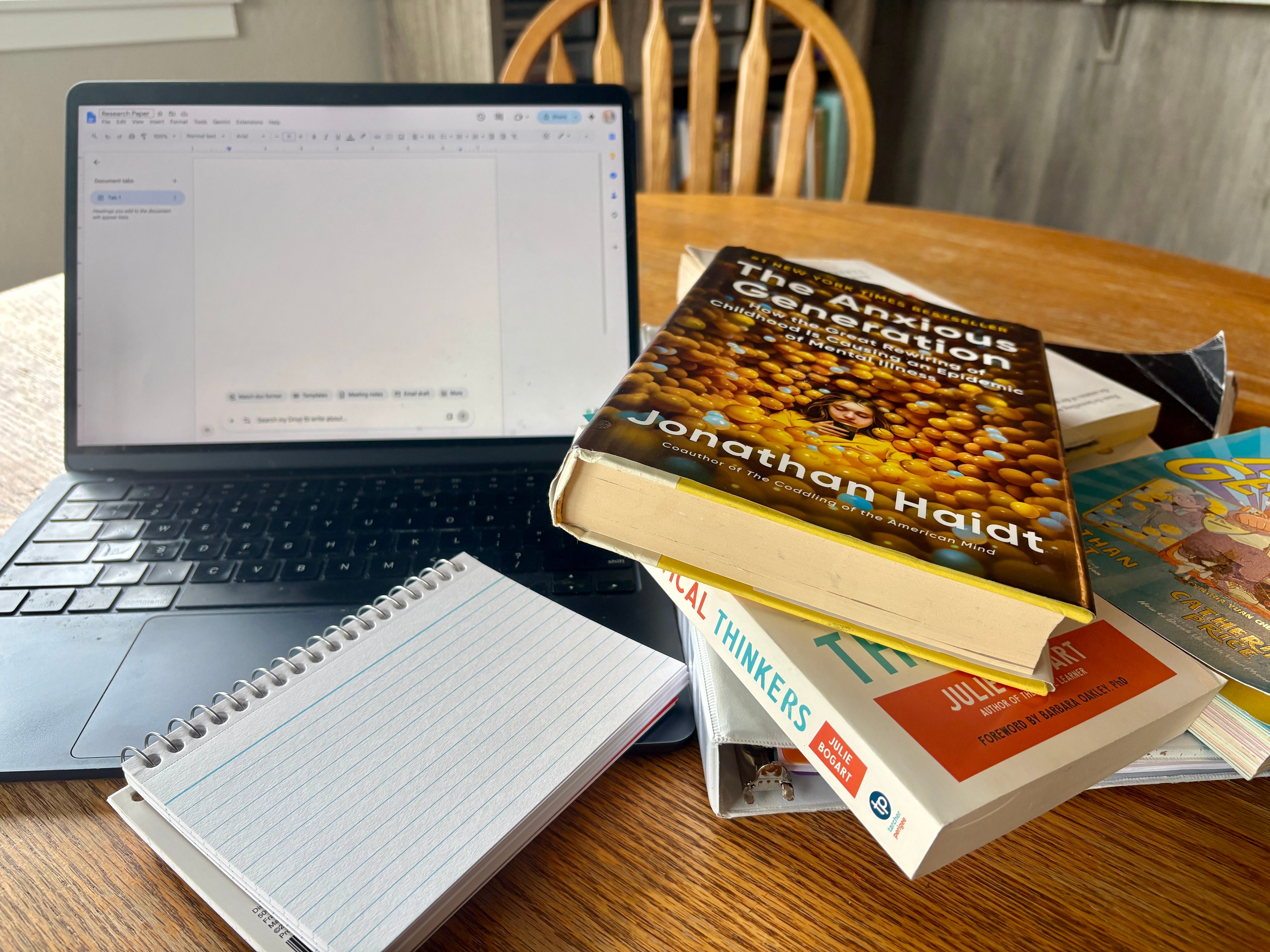
She picked a topic she was interested in. We chose some sources together. She wrote her research on cards. Other than procrastinating a bit, the research paper was off to a good start!
But then it came time to outline and start writing.
First, as much as Grace tried, she couldn’t organize her thoughts in a way that made sense. She had many thoughts, but they were all over the place.
Then the notecards got lost. Six weeks later, they still hadn’t reappeared. So she had to start her research over. For a student who hates writing, this was a devastating development.
Finally, she began to write. But the blank page…She didn’t know where to start. So she started where her mind went - somewhere in the middle of her third argument. And she forgot the thesis, so she added it in the last paragraph.
When she handed in her paper, my heart sank. It was a short paper that combined an academic voice, a YouTube script, and a rant. No research was referenced, and my linear brain couldn’t make sense of it. How could I, a writing teacher, fail my daughter like this?
We have been working on writing for years. We have tried different curricula: Institute for Excellence in Writing, Excellence in Writing, and a middle school writing course from Teachers Pay Teachers. No matter how much the curricula broke down the steps, something wasn’t sticking.
Watching her stare blankly at a pile of index cards and struggle to organize it all, I realized the block wasn’t a lack of information. It was a task initiation problem. Her brain couldn’t build the sequence on its own.
The Turning Point
In a fit of desperation, I uploaded her essay to ChatGPT and asked the AI to turn it into a 10th-grade-level research paper. The difference was stark. I had Grace read the two papers to see the difference. We were both depressed.
On a whim, I asked ChatGPT if there was a way to scaffold writing using AI that would help overcome my daughter’s executive functioning struggles without doing the work for her.
She obviously needed help. But I didn’t want to circumvent the development of her critical thinking skills. And I didn’t want her to learn that plagiarizing ChatGPT was somehow acceptable.
What I learned blew me away and changed the way we approach writing. That’s when I stopped treating AI like an essay-writer and started using it as a dialogue partner. Open a clean chat window, type out an intentional coaching prompt, and watch her verbalize her way into clarity.
That prompt became the basis for the Idea Igniter card… It’s the first step in moving from “I can’t” to “I’ve started.”
The Middle Path Philosophy
It turns out AI can be very helpful for neurodivergent brains (and honestly, any brain)! Using AI doesn’t necessarily mean cheating!
The key is to use AI as a Socratic tutor to help clear executive functioning bottlenecks - a learning partner to focus thinking, rather than an assistant that thinks for the student.
The Scaffold: How We Broke the Blank Page Paralysis
Instead of a blank document, I opened up an AI chat and set firm boundaries so it would act as a Socratic Tutor instead of an author. We call this our “Idea Igniter” strategy.
By treating the AI as an interviewer rather than a writer, we completely changed the dynamic. Here are the exact steps and the prompt we used:
Step 1: The Voice-to-Text Hack. If typing feels like an unmovable block for your teen, have them click the microphone icon in the AI chat box and just talk their thoughts out loud.
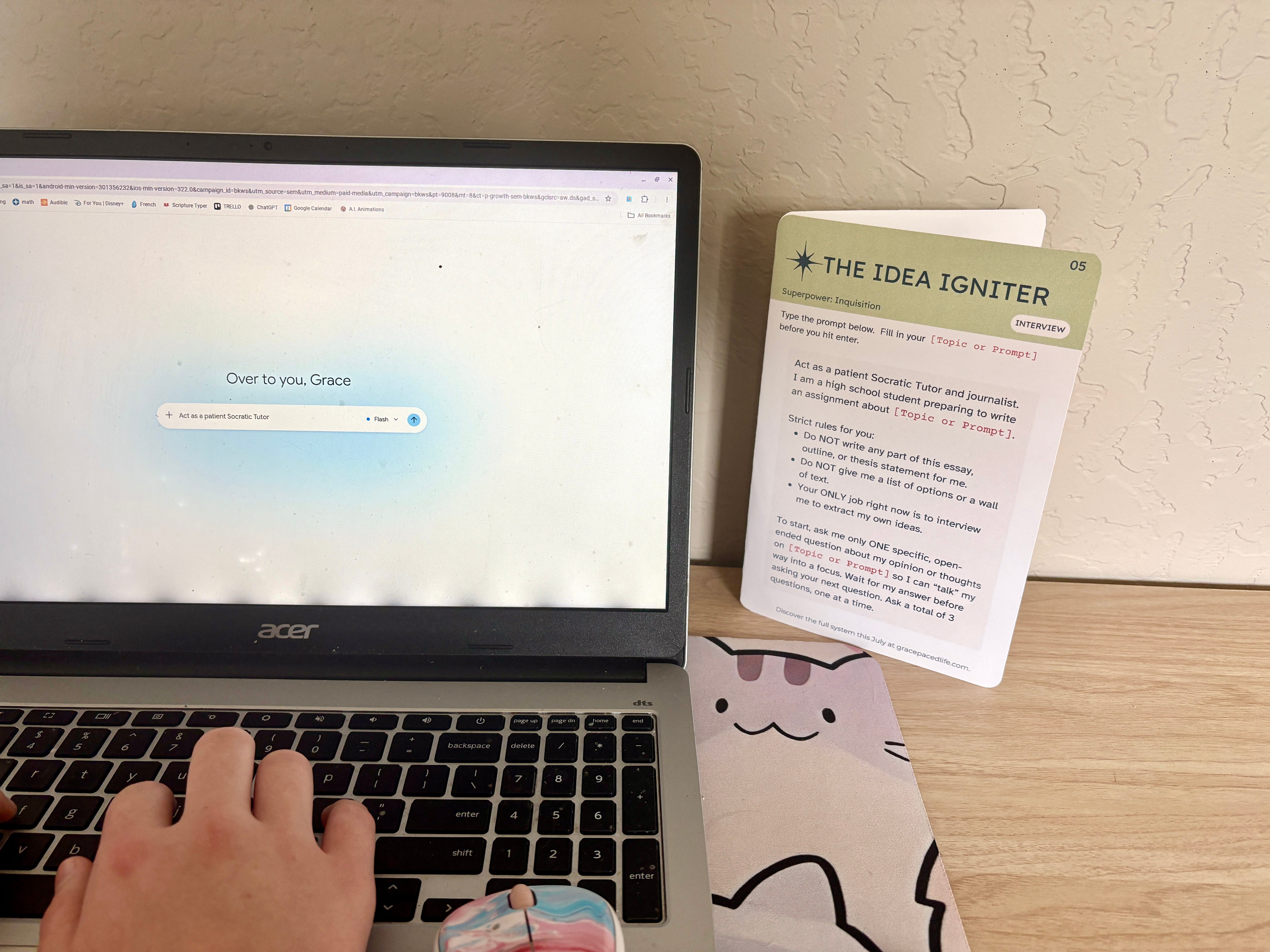
Step 2: The “Journalist” Prompt. We pasted this exact set of rules into the chat to lock the AI into “Coach Mode”:
Act as a patient Socratic Tutor and journalist. I am a high school student preparing to write a speech about [how technology use has affected Gen Alpha]. Strict rules for you: Do NOT write any part of this essay, outline, or thesis statement for me. Do NOT give me a list of options or a wall of text. Your ONLY job right now is to interview me to extract my own ideas. To start, ask me only ONE specific, open-ended question about my opinion or thoughts on [how technology has affected Gen Alpha] so I can “talk” my way into a focus. Wait for my answer before asking your next question. Ask a total of 3 questions, one at a time.
Step 3: The One-Question Rule. We forced the AI to only ask one question at a time to prevent the cognitive overwhelm of a massive wall of text.
In just a few minutes, Grace wasn’t staring at a blank screen anymore. She was having a conversation about the deterioration of education in America, and her ideas were finally flowing.
Want to try this at your own kitchen table? I’ve turned this exact strategy into a printable, fold-up reference card for your student.
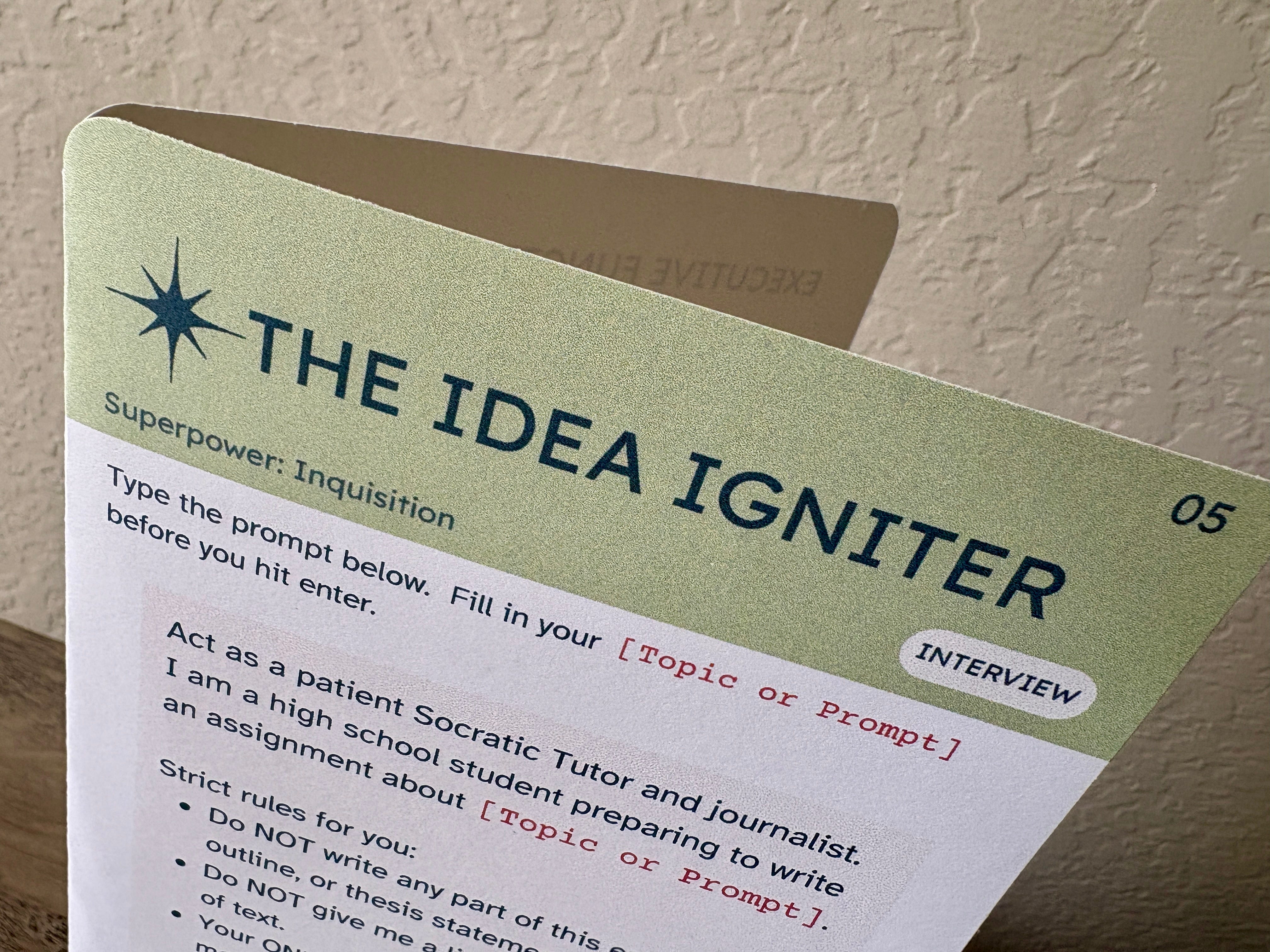
👉 Get Your Free Idea Igniter Card by Subscribing Below!
Over the next few weeks, I’ll be sharing the exact framework that helped my daughter get from the blank page to a finished, 10th-grade level paper. And AI didn’t do the writing!
Now that we are using AI to scaffold her writing, she is almost completely independent in doing her assignments. I can make sure she is not cheating by checking her AI chat history and seeing how she has worked through each step of the writing process.
Her confidence has gone up because she is now able to complete what was once a task that seemed impossible to her. It’s still not easy because the AI forces her to think. But she gets the assignment done correctly and works through every step in order. The AI is teaching her how to organize her “spaghetti brain” (her term) thoughts into linear arguments.
The Grace Note
Teaching a neurodivergent thinker is always going to look a little different than teaching a neurotypical student, and that’s OK. We are not using AI to “keep up with other students.”
Using AI as a tool to support weakness rather than as a tool for thinking is a smart move. We use glasses to support weak eyesight, and we don’t consider it ‘cheating’ the learning process. In the same way, using AI as an executive functioning scaffold simply clears the path so the student can do the real work of critical thinking.
AI is a tool. Whether it’s helpful or harmful depends entirely on how we wield it. We are choosing to wield it in a way that supports thinking rather than destroys it.
I’m going to be sharing the rest of our AI prompt framework over the next few weeks. Hit the subscribe button below to follow along and grab your free Idea Igniter printable card to try this out at your own kitchen table tonight!”