
I was browsing Facebook recently, when a beautiful image caught my eye.
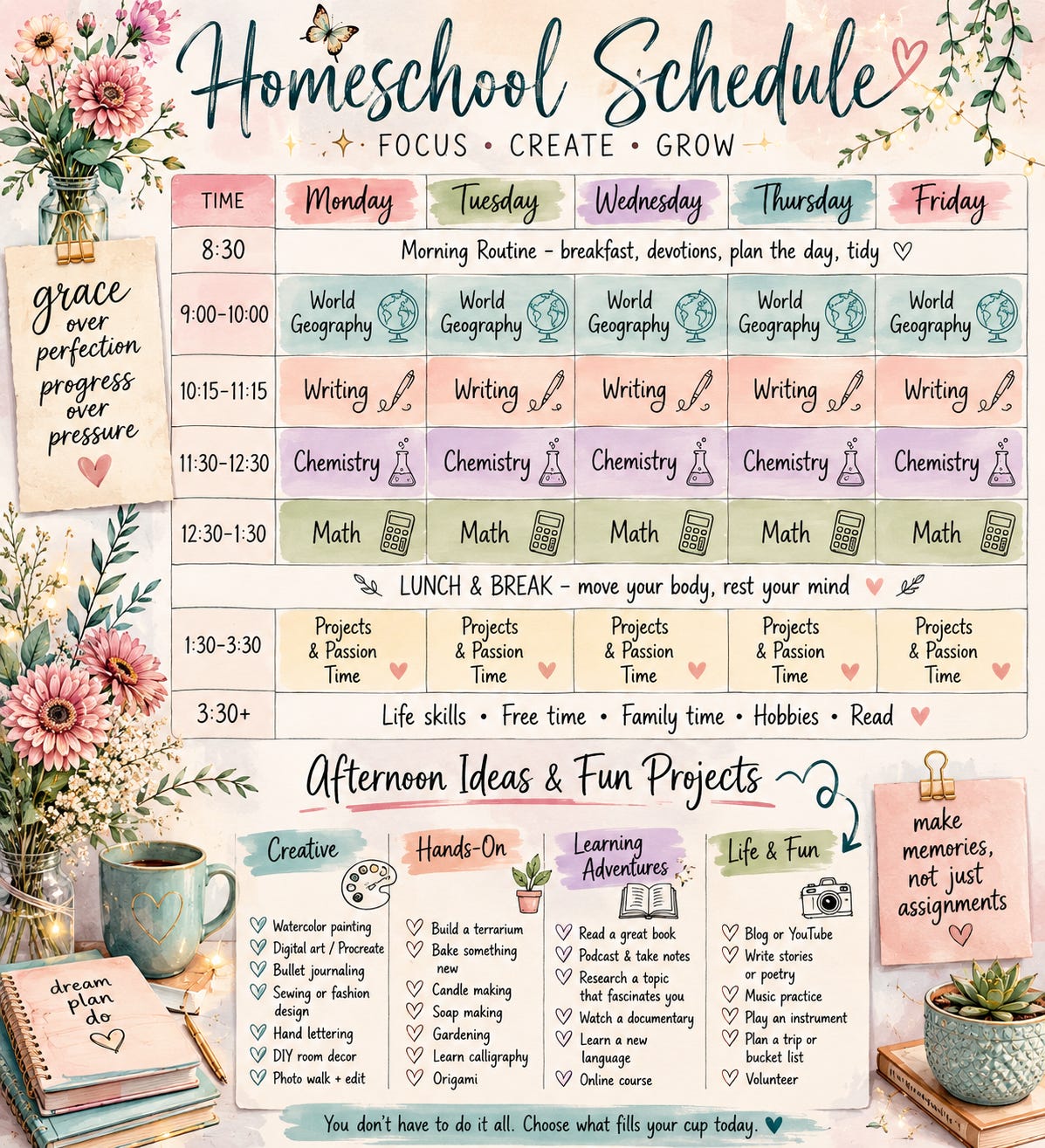
In one of the homeschooling groups I frequent, a young homeschooling mom had posted a beautiful schedule she intended to use when school begins in the fall.
The colors were aesthetic. The font was elegant, yet easily readable. And each homeschool day was meticulously scheduled down to the minute.
It was a work of art, created by ChatGPT.
To the mom’s credit, ChatGPT created exactly what she instructed it to, and the result was stunning, every organizer’s dream.
While I didn’t want to share that mom’s exact schedule, I created a similar schedule to show you what I mean.
I can plug all of my daughter’s assignments into AI and generate a perfect schedule. And AI does a wonderful job of organizing the information.
I have been that mom, creating the aesthetically perfect schedule. By nature, I am a planner. Every year, I make our homeschool plan.
And every year it fails.
By the second week of school.
The Problem With The Perfect Plan
Why does this happen year after year?
The answer is simple. Because I plan for my brain, not my daughter’s. And my daughter is not a planner.
I can plug all of my daughter’s assignments into AI and generate a perfect schedule. And AI does a wonderful job of organizing the information.
But AI is not human. It cannot account for low-energy days, schedules that change on short notice, or even illness.
When a perfect plan is made, and the unexpected happens, the perfect plan fails. Fixing it takes a lot of time and effort. Even more importantly, a neurodivergent teen can feel overwhelmed by that “I’m so far behind!” feeling.
Designing for the Learner’s Brain
It took me a while to come up with a system that worked for both my daughter and me.
Before I built the system, I listed my “requirements.”
For me:
My involvement in the school day needed to be done by 3:00. My energy tanks in the late afternoon.
As I work more hours as a substitute teacher, the plan needed to be open and go.
That’s about it for me. Since my daughter is now in high school, I’m trying to teach her to be more independent with her work.
My requirements for my daughter were a little more strict:
It needed to provide independence.
But it also needed to provide some structure.
It had to take into account that she is easily distracted.
And that her energy varies from day to day.
And that she’s a teenager whose schedule changes frequently.
It had to help her learn to manage bigger projects on her own.
But it couldn’t leave all the bigger projects for her to figure out herself. That would be a disaster.
In a nutshell, it had to teach her the way to independence without dumping her in the sea without a lifeboat.
A schedule built entirely by the parent (or by an AI on behalf of the parent) is a tool for parent compliance. It says, “Do this at 9:00 AM because the paper says so.”
Real independence happens when we transition from a parent-managed calendar to a student-managed navigation system. We need to build a digital environment where the teen can see the destination but navigate the terrain themselves.
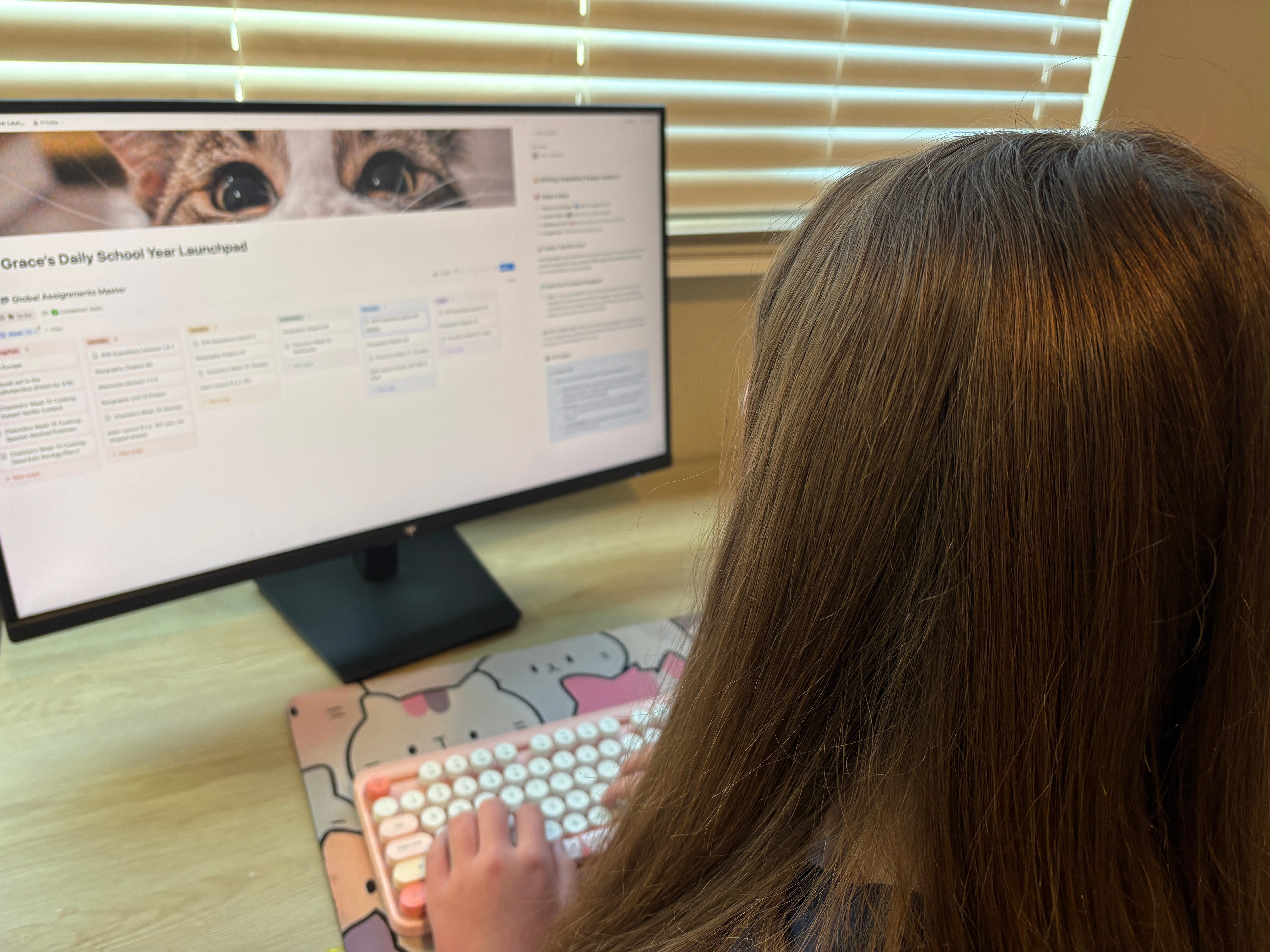
That shift, from compliance to navigation, is what you see in the opening photo. Grace is interacting with her customized dashboard. It’s calm, focused, and completely hers. Let’s look at how that architecture actually functions…
The Practical Peek: Our Notion System
In the past, we’ve used rigid schedules, like the one I found on Facebook. But a calendar that says “Writing: 10:00-11:00” is way too general to work for my organizationally-challenged daughter, who also happens to suffer from extreme time-blindness. She stares at the assignment and procrastinates because she doesn’t know where to start.
Instead of fighting against her natural challenges, we decided to work with them.
This year, we are making good use of the technology available to help her manage her own schedule and assist her in executive functioning. Notion and NotebookLM are cornerstones of our plan this year.
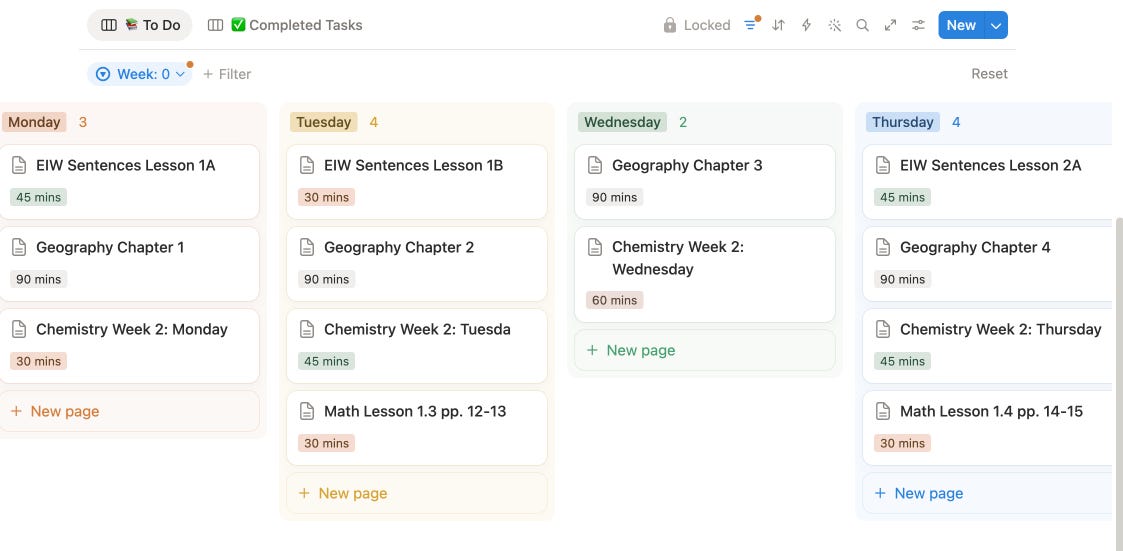
A database in Notion holds all of her assignments, showing her a week of assignments at a time, sorted into days. Each assignment has an estimated time attached to it to combat time-blindness and help her see time clearly (instead of stretching four hours of work into 12).
Each individual lesson page neatly lists materials, steps, a clear finishing point, and necessary links. Instead of just assigning a massive task like “Write the Body Paragraphs,” I built the AI prompt directly into the page layout.
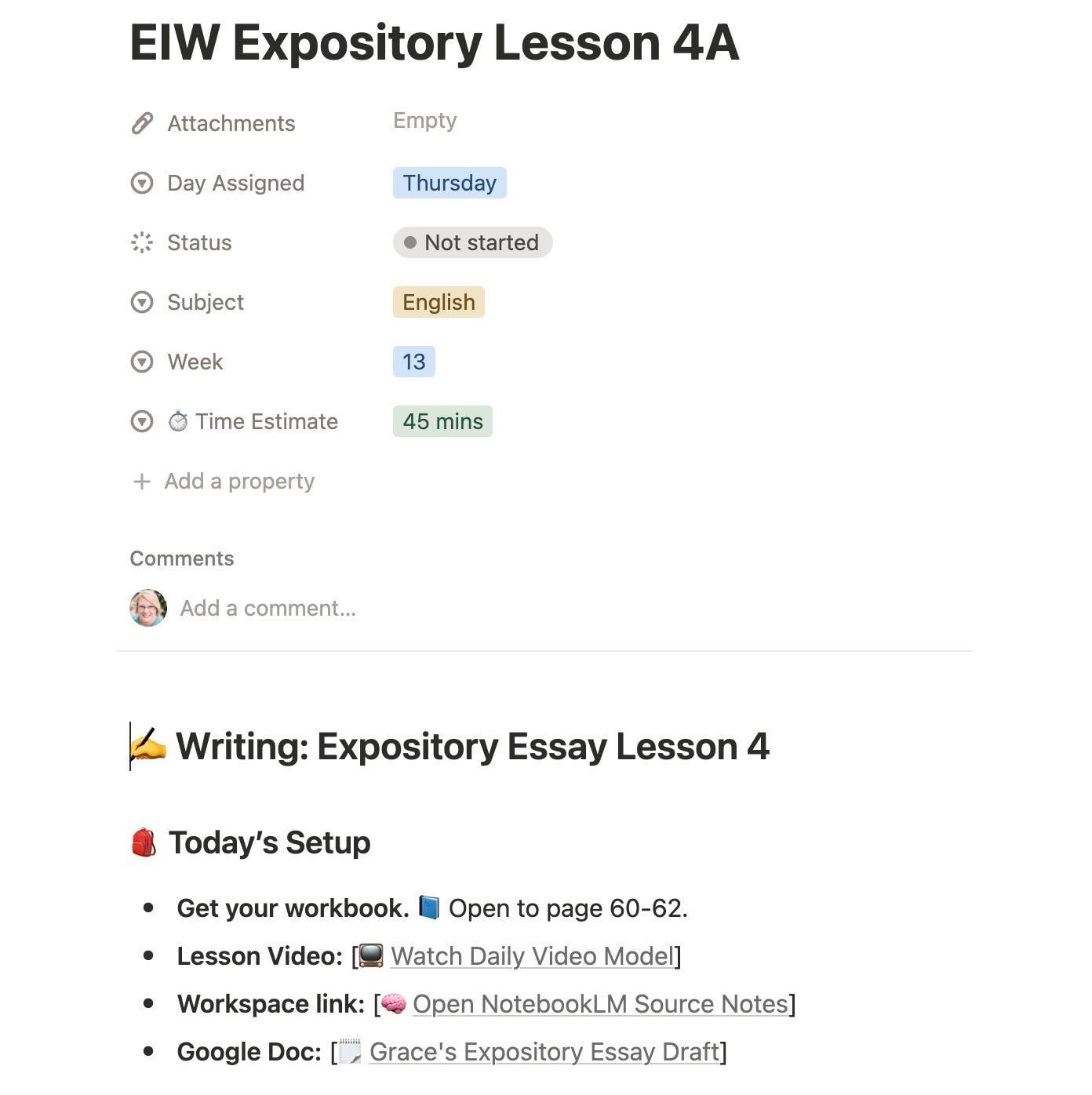
When she has a writing assignment, instead of just staring at a blank cursor, she opens the page to find Card 13: The Paragraph Architect embedded directly into the layout.
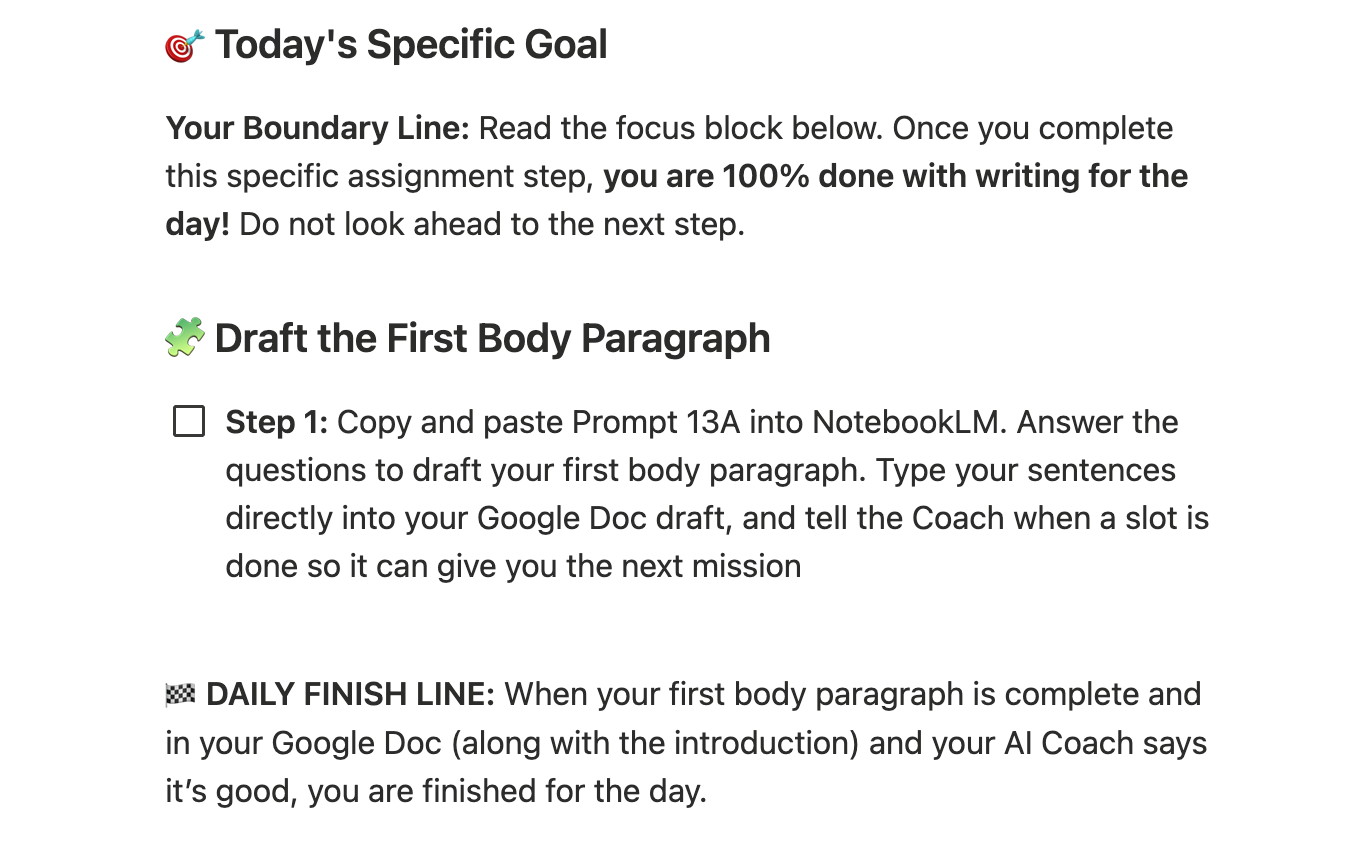
She doesn’t need to ask for a template or remember how to structure a paragraph. The Architect is sitting right there. She copies the prompt, uses it to map out her sentence structure or logic flow, and then starts writing.
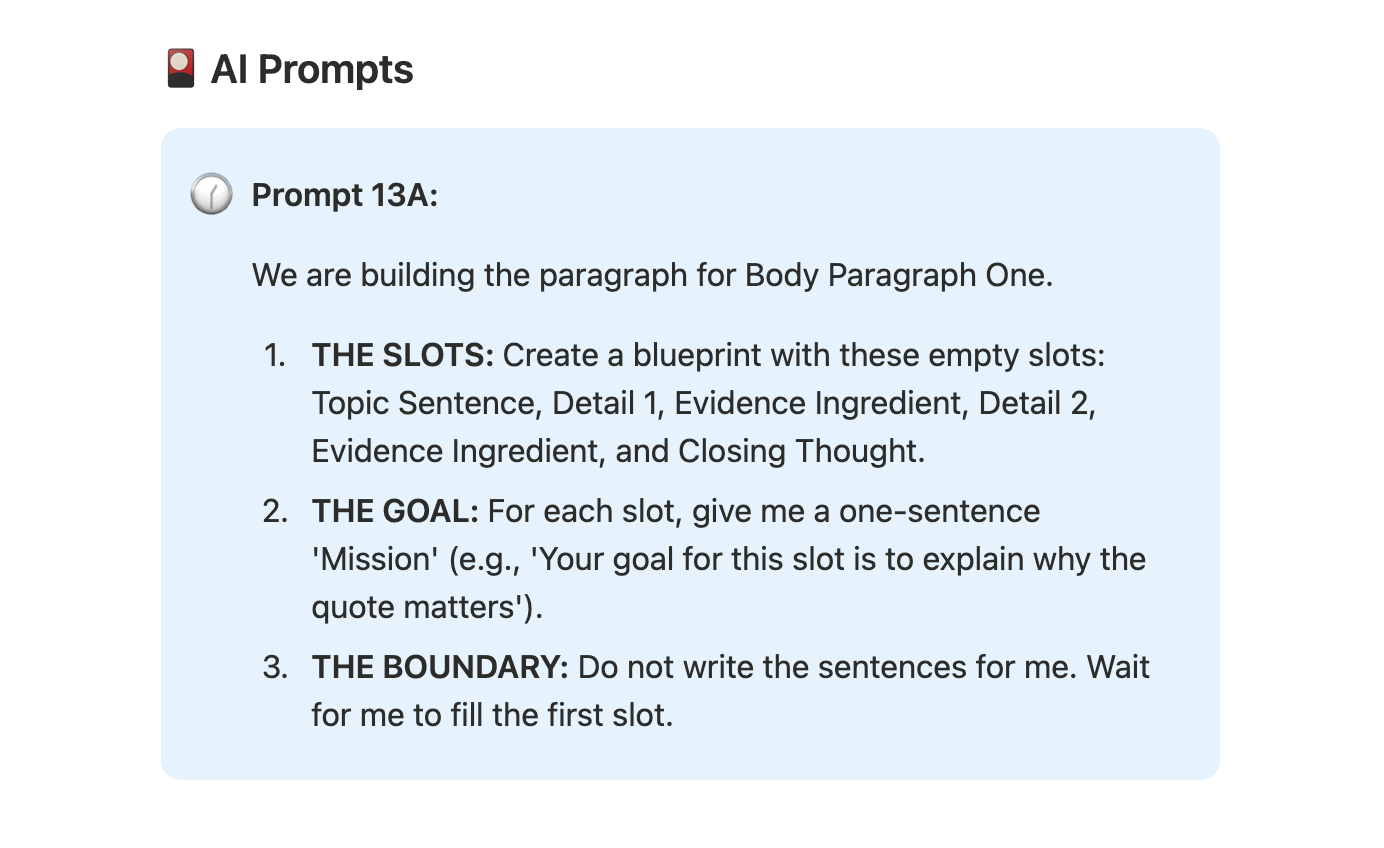
The architecture of the paragraph is built before the first sentence is written. The “scaffold” removes the paralyzing question of “how do I start?” and allows her to get right to the thinking.
Finally, instead of a rigid time schedule, each card is tagged “not started,” “in progress,” or “done.” She controls the “when” of her day, and the visual tags give her immediate feedback on her progress.
Why Go Through All the Trouble?
I’m not going to lie. It takes a while to set up a system like this. Is it worth it?
Absolutely yes.
When your child has a severe case of ADHD, she doesn’t just need to learn to read, write, and do arithmetic.
She needs to learn how to work around her executive dysfunction. By creating a system that she can manage herself, I have given her the tools she needs to:
See time more clearly (the time estimates)
Break down projects (the AI prompts)
Organize her day herself (the assignment statuses)
Make sure she is prepared for the assignment (the supply list)
Furthermore, she is learning to use tools that may very well help her for the rest of her life.
Scaffold, Not Shortcut
We cannot automate our kids into independence. ChatGPT can make a schedule, but it cannot teach a teen how to navigate a hard assignment when they are tired or distracted.
True educational strategy isn’t about finding the perfect automated planner; it’s about giving our kids operational tools that reduce friction and respect their natural pace.
The beauty of a system like the one I’m using with Notion and NotebookLM is that when my daughter graduates and goes off into the real world, these same two tools can help her manage her work, her house, and anything else she needs to manage.
For a person who admits her brain has a difficult time holding information, a system like this is life-changing.
When we build environments that support their executive functioning instead of demanding rigid compliance, we give them room to actually think. And that’s where real learning begins.