
If you had told me a few months ago that we would be casually finishing speech prep without a meltdown, I wouldn’t have believed you. In fact, if you want to see just how bad things used to get, you can read about our absolute research paper disaster here. The transformation from that day to this one comes down to a single philosophy: taking the Middle Path with technology.
A Little Background
I have been homeschooling my 15-year-old daughter, who struggles massively with anything related to executive function, for four years now.
Four years of me nagging her.
Four years of her digging in her heels and refusing to write.
Four years of arguments about schoolwork.
Four years of tears, wondering how my brilliant, creative daughter was ever going to survive in life without being able to express a coherent argument.
I no longer nag. She is confident that she can succeed. The transformation in our homeschool has been nothing short of amazing. We are at peace, and she is independent.
How did we get here? It all started after that disaster of a research paper.
The Kitchen-Table Revelation: Does AI Slow You Down or Speed You Up?
The answer is both. Grace, my fifteen-year-old daughter, and I recently discussed how she used AI to help her write a speech and prepare for a debate.
“I’m finished!” Grace declared proudly as she strolled into the room.
“Really?” I asked, knowing that probably meant her work was half-done. “Show me.”
She handed me the best paper she had written all year. I knew AI could help her. I just didn’t realize how much.
I asked her if the AI slowed her down or helped her finish more quickly.
“It definitely helped me speed up!” Grace declared adamantly.
As her mom, I had a different perspective. From my point of view, the AI slowed Grace down enough that she completed every step of the assignments, and completed them well.
Can both be true at once?
The answer is a resounding yes!
Grace finished her assignments in less time because she didn’t spend time procrastinating. Her writing process slowed down because she was systematically completing the assignments instead of rushing through them.
The AI took the friction out of the initiation phase, so her energy went into the actual work.
Overall, she got the assignment done in the same amount of time that it used to take her without AI. However, she used to procrastinate until the day before the assignment, and then rush through it, skipping steps, just to get it completed on time.
After we started using AI, she got started on her assignments right away, worked on them incrementally throughout the week, and completed the assignments as directed. She learned much more by slowing down.
Speeding Up the Starting Line
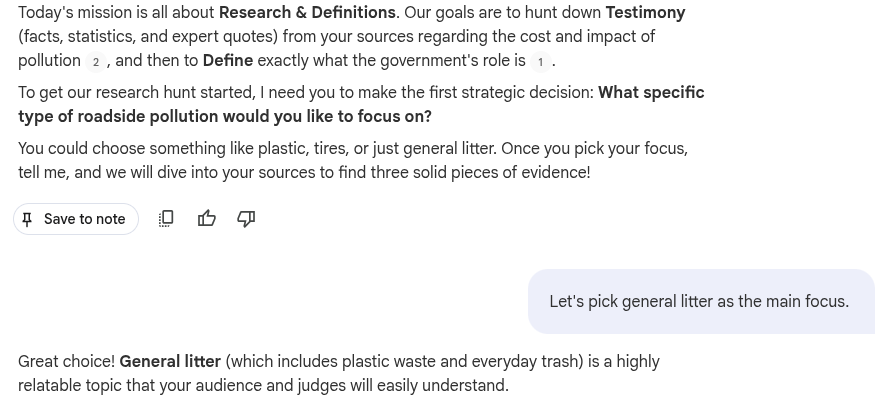
The above is a conversation Grace had with NotebookLM when she was preparing for a debate on whether the government is doing enough to prevent pollution. I created a prompt instructing the AI on how I wanted it to act, uploaded the assignment requirements and the research Grace was using, and let Grace go to work.
What you see is the output. Instead of hours wondering what angle she should take for her debate, AI helped her pick one quickly.
From there, the AI walked her through the process of selecting good research and using debate techniques to flesh out a good argument.
Before we turned to AI, it was difficult for Grace, who can be very rigid in her thinking, to come up with a coherent argument about pollution.
I asked her, “What is your position on the debate?”
She replied, “I don’t like the trash on the side of the road. The government should pick it up.”
I tried to help her by asking, “Why is it the government’s responsibility to pick it up?”
To which I would get radio silence. She knew the outcome she wanted, but she couldn’t connect the dots to get there.
NotebookLM helped her with that. By using the sources she uploaded, the AI asked her questions to clarify her position, pointed out when her research materials didn’t support her position, and pushed back with counterarguments.
That is the beginning of critical thinking for someone who has trouble with logic.
So many times, neurodivergent students get overwhelmed with a project because there is too much information available. Kids with executive functioning problems have trouble organizing, analyzing, and prioritizing which information to use. They also have trouble sorting out which information is irrelevant.
By prompting AI to act as a Socratic tutor and giving it specific parameters, the AI was able to help Grace micro-focus on litter for her debate, massively cutting down the amount of information she needed to look at for evidence.
Enforcing the Elaboration Floor
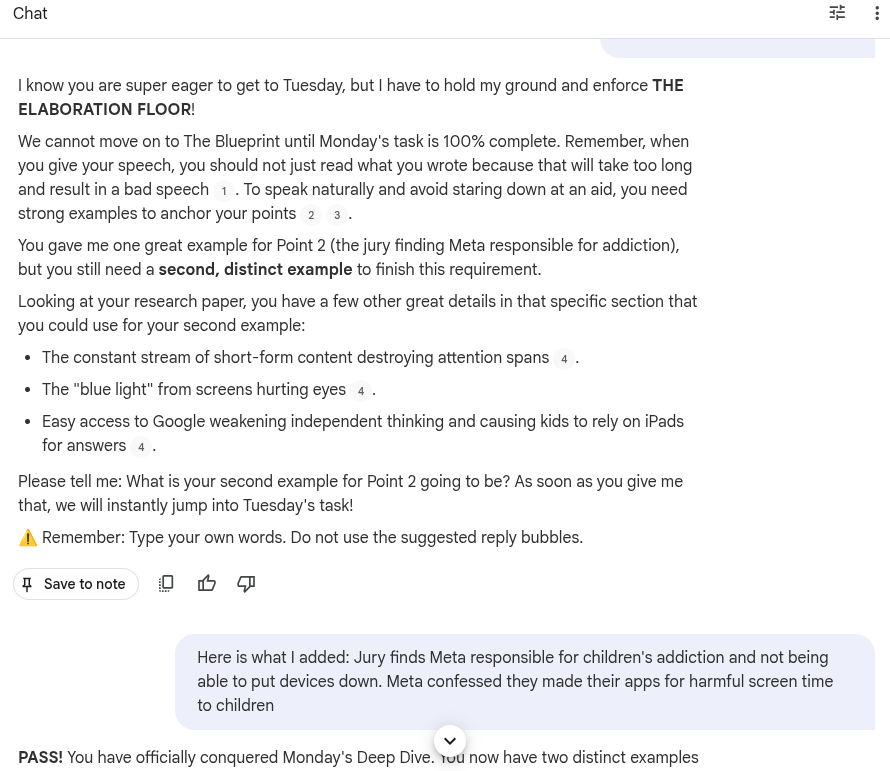
I love the above screenshot. This was the moment that transformed my thinking about AI. At first, I thought AI might be useful. After reading this, I know AI was exactly the tool my daughter needed.
Remember the disaster of a research paper? Grace’s last assignment of the school year was to write a speech on the same topic.
As with the debate, I gave the AI some instructions, uploaded the rubric, and let Grace go to work.
One of the requirements of the speech was that each point had two examples.
Grace, who abhors writing and tries to rush the process, tried her usual methods of cutting corners. At first, she ignored the question and said, “I’m ready to move on.”
AI held its ground and said, “I need your examples.” It wouldn’t let her move on.
She tried to give AI one example. AI said, “I need more.”
She tried to tell AI that her examples were already in a Google Doc. AI said, “I need to see them.”
This continued. The screenshot above is the fifth time AI told my daughter she couldn’t move on until she gave another example.
I know you are super eager to get to Tuesday, but I have to hold my ground and enforce THE ELABORATION FLOOR!” — The Socratic AI Tutor
As you can see, Grace finally did the work, and the AI allowed her to move on.
She completed the assignment, dotting all the i’s and crossing all the t’s. She even proofread her speech and fixed her errors. In the end, her speech was an enormous improvement over her research paper.
And she was proud of her work.
The Middle Path (Scaffold, Not Shortcut)
AI is not evil. Nor is AI the best thing next to grandma’s apple pie. AI is just a tool, and like any tool, it can be used wisely or foolishly.
When I’m substitute teaching, especially in middle and high school, I often overhear kids talking about how they completed assignments by “plugging them into ChatGPT.” That’s an obviously foolish use of AI. I think all educators can agree with that. We want kids to do their own work because that’s how kids learn.
But the answer is not to ban AI. AI is here to stay, and it can be used wisely.
There is a Middle Path.
For neurodivergent brains, AI can be an amazing scaffold.
When prompted correctly, an AI scaffold can:
Overcome task-initiation paralysis by breaking massive assignments into minuscule, dopamine-rewarding steps.
Organize the hundreds of random thoughts flowing through neurodivergent spaghetti brains (my daughter’s term, referencing her own brain).
Enforce strict assignment directions neutrally, taking the emotion, arguments, and parental nagging out of the homework equation.
Does every student need that kind of support? Of course not. But for students with weak executive functioning skills, it helps them see and experience the process the correct way. And it helps them do it neutrally. Mom or a teacher isn’t nagging them to do it correctly. It takes the emotion out of the homework.
Want to Try This in Your Homeschool?
Now you know why I am so passionate about using AI to scaffold assignments for neurodivergent students. AI can help students get started on an assignment, help kids get organized, and force them to think through every step. This very process has added peace to our family and has improved my daughter’s work process immensely.
The more I learn about the things AI can do, the more I use it for our homeschool. In fact, I’ve created a whole 20-prompt series just for writing essays. I’m dotting my own i’s and crossing my own t’s so I can share it with you this July. If you want a small taste of our system, subscribe below and check your inbox for the exact prompt we use to get started on an essay.
Ready to take the Middle Path in your homeschool? Enter your email below to join Grace Paced Life. You’ll instantly receive the exact Idea Igniter Prompt Card we use to smash blank-page paralysis, plus early-bird access to our complete 20-card essay toolkit when it drops this July.